Friday, March 28, 2014

Eleutheran Adventures

Powell Point, Eleuthera to Royal Island
February 27 ‒ March 9

The first Europeans who established a permanent settlement on this island in 1648 based their name on the Greek word for freedom, calling themselves the Eleutheran Adventurers. Their experience on these shores included shipwreck and hardship. Our adventure was of a much more delightful and relaxing variety.

We’d never visited Eleuthera before, so we rented a car one day and toured the island from the southern tip to Governor’s Harbour—about half of its 110-mile length. We were so impressed by the gorgeous scenery we kept discovering that it became our new favorite island.

Cottage on Cupid's Cay across from Governor's Harbour
Eleuthera is jam-packed with natural beauty. White and pink sand beaches stretch for miles along its coasts. Majestic cliffs and massive boulders rise above the beaches. Magnificent views of the bright aqua Bight of Eleuthera on the west and the cobalt Atlantic Ocean to the east can sometimes be seen from the same place.

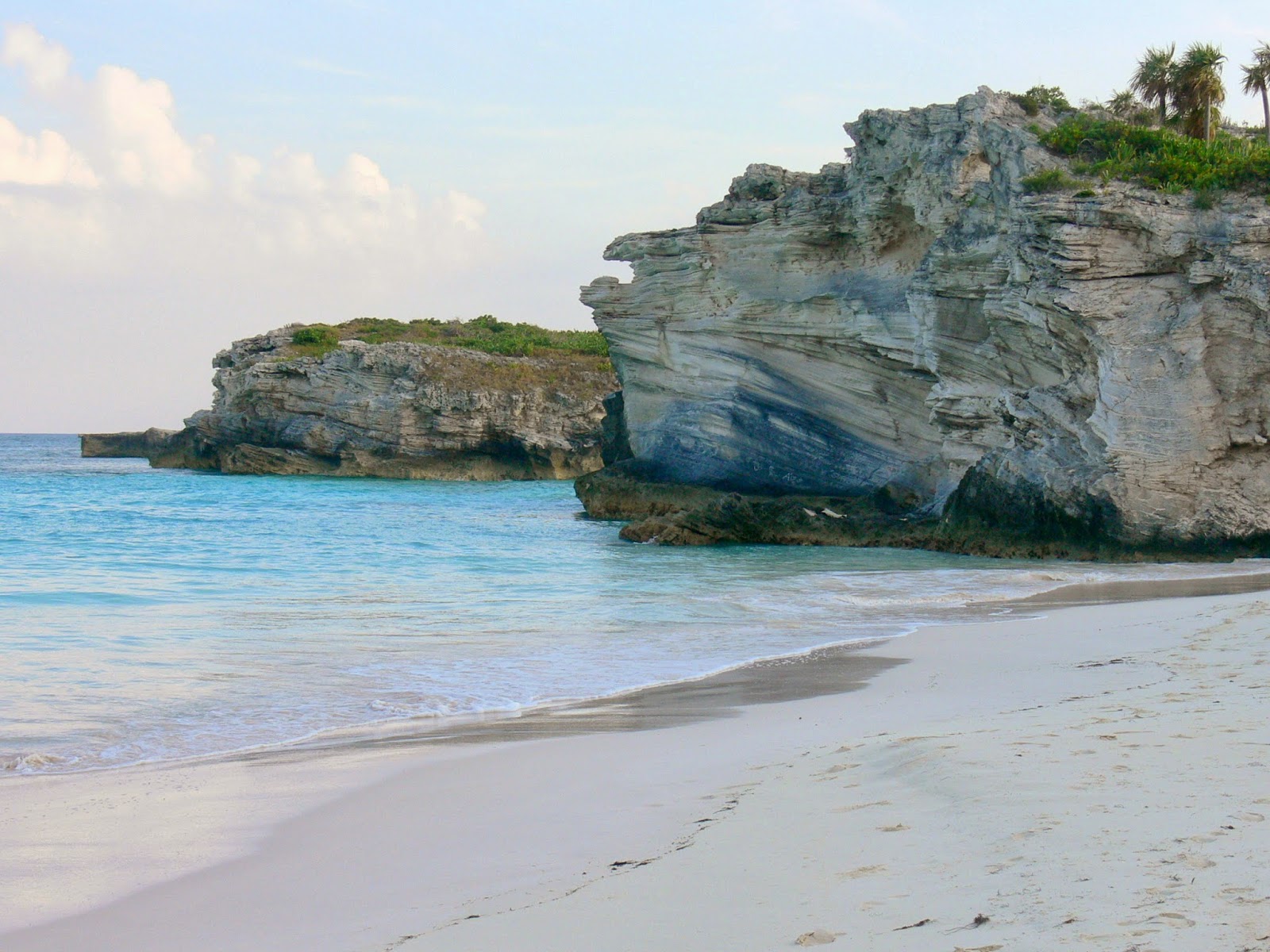
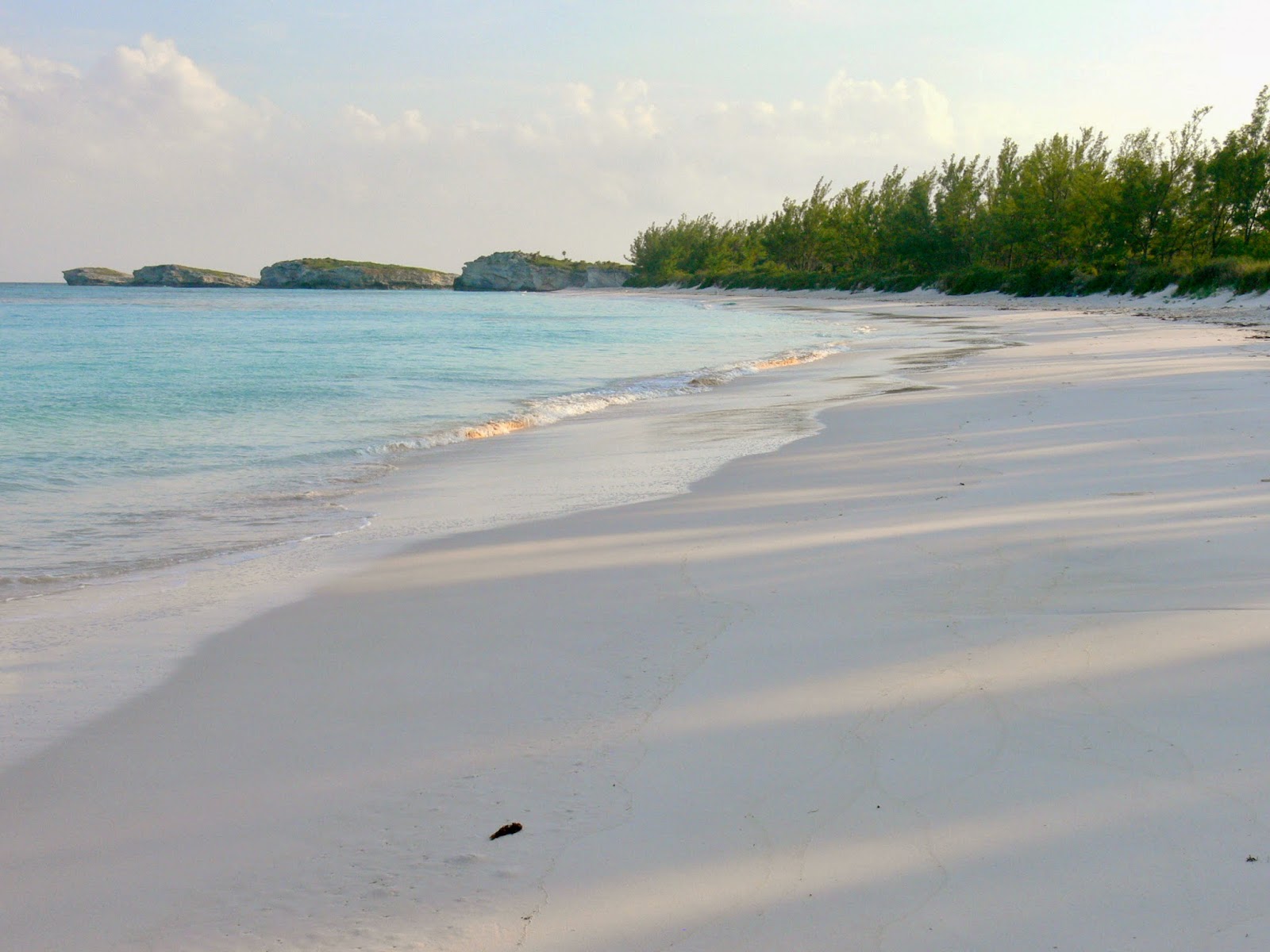
Our lunch stop was Governor’s Harbour, a picturesque village with quaint New England‒style cottages that stair-step up a hill. A causeway connects the town to Cupid’s Cay, where the Eleutheran Adventurers first made landfall. We drove beach access roads and walked on beautiful beaches. And at the end of the day, we found it: the beach that surpasses all the others we’ve seen so far! They say that nothing but a four-wheel-drive vehicle can manage the last few miles of the drive to Lighthouse Point Beach. But Keith maneuvered our compact rental through deep, sandy potholes and ruts between walls of tough shrubbery along both sides. The view at the end of the road made every bump worthwhile.
Lighthouse Point Beach (late in the day, the picture doesn't do it justice!)
Cliffs at Lighthouse Point
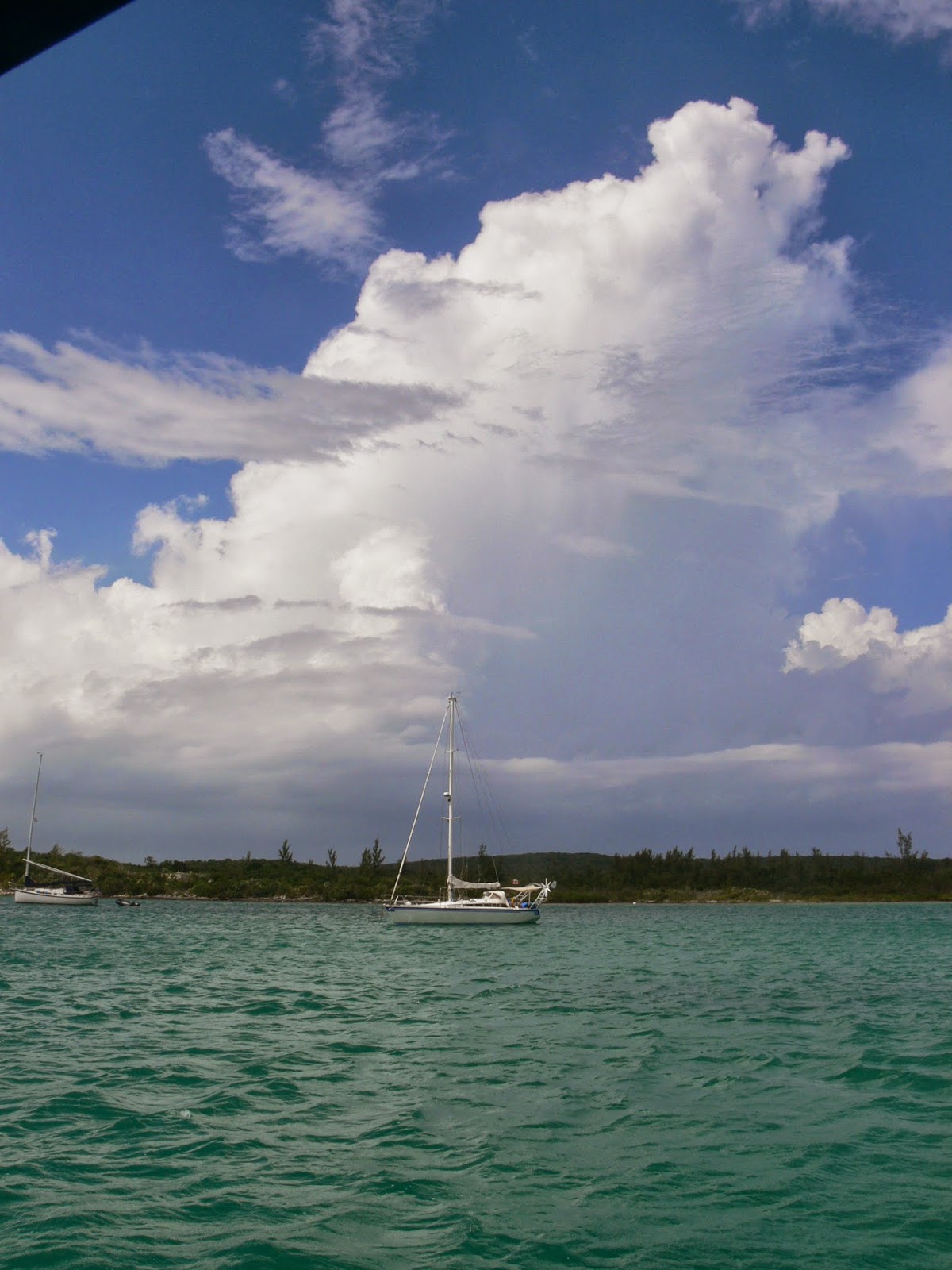
Because of a pattern of repeating cold fronts with strong westerly and northerly winds—and the fact that there are few good harbors on Eleuthera for those winds—we didn't mosey around as much as we’d have liked. We spent several nights at Cape Eleuthera Marina, anchored for one night at Governor’s Harbour, and then moved on to Hatchet Bay Pond, a hidey-hole with all-around protection, to wait out the next storm.

The Front Porch Restaurant in Harchet Bay
There weren’t many thriving enterprises in Hatchet Bay, which made The Front Porch restaurant even more of a find. Francis, the owner/chef, had been out the previous day and had fresh stone crab claws and crawfish (lobster). I ordered crawfish stuffed with fresh crab meat (a great choice for the indecisive), and Keith went for the claws. The biggest stone crab claw on his plate was the size of his hand; including the knuckle, the claw extended a few inches up his wrist. It was all fabulous.

Storm clouds at Hatchet Bay Pond
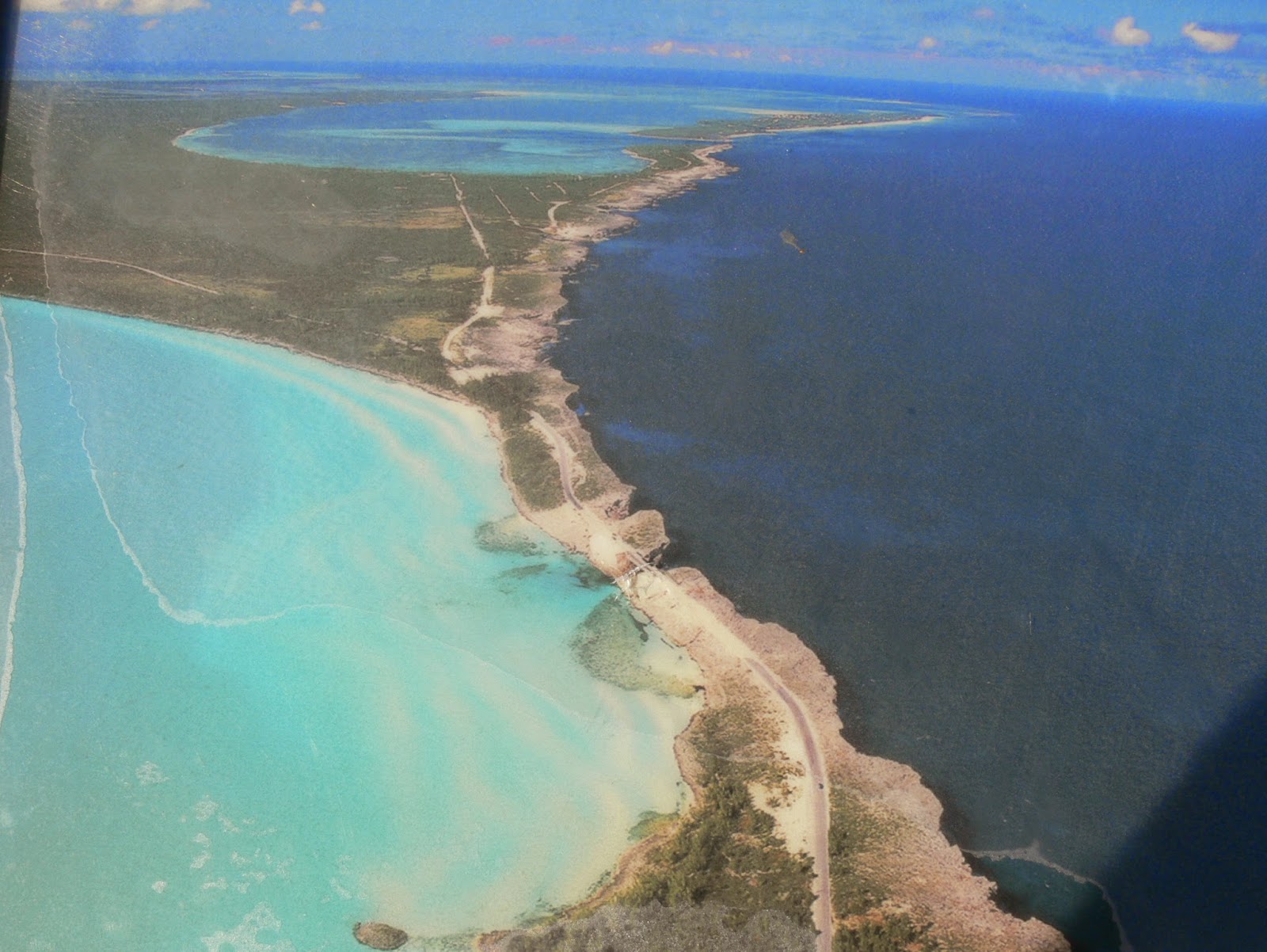
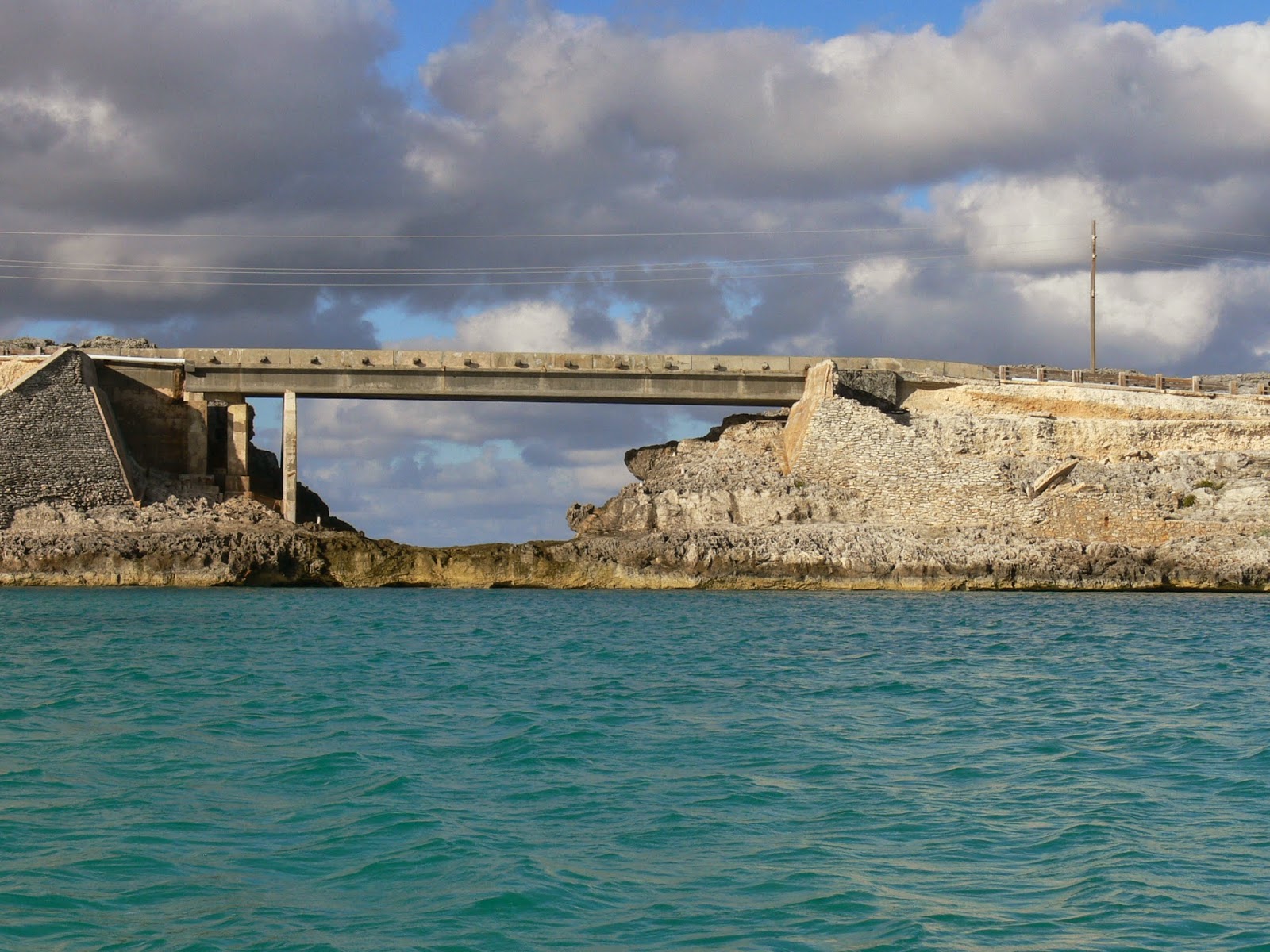
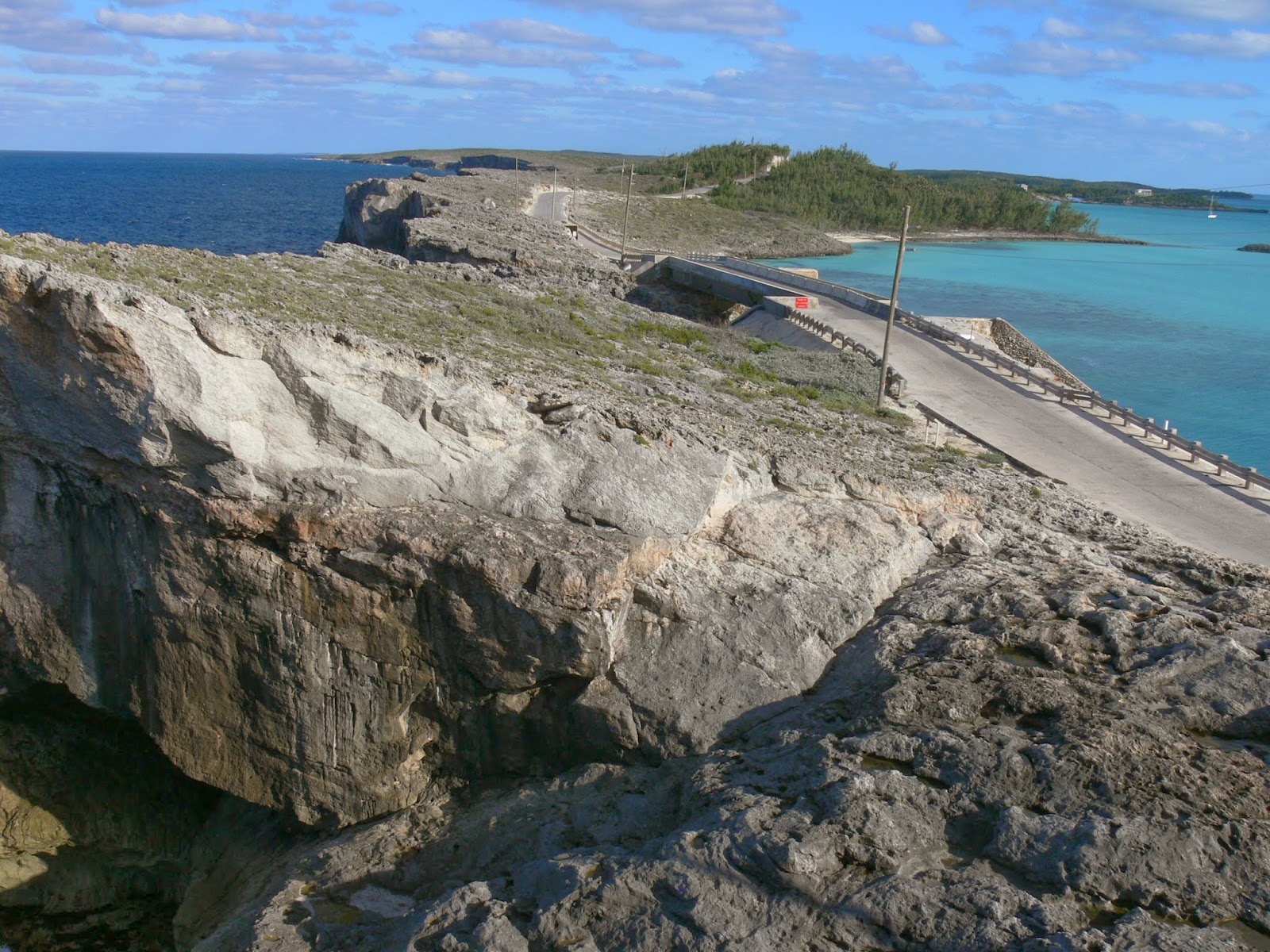
Once the storm passed through, we moved farther north and anchored by the Glass Window, a tiny isthmus sometimes referred to as “the narrowest place on earth” (less than 100 feet). It connects the northern section of Eleuthera with the rest of the island and dramatically contrasts vivid turquoise waters with the deep-azure Atlantic. The Glass Window was named when a large stone arch crossed the narrow section. The force of a hurricane swept the arch away in the early 1920s. A couple highway bridges have since spanned the gap. On Halloween of 1991, a formidable wave moved one end of the latest bridge over by seven feet—but it’s still in use, one lane only!
The contrast between turquoise and blue at the Glass Window
The Glass Window bridge.
Waves can sweep over the top even on a clear day!
If you look closely, you can see the offset of the bridge at the orange sign.
And Pelican is in the right top corner.
Even the departure from Eleuthera had potential to be an adventure of the wrong kind. Ebb or flood tides at Current Cut, an opening 100 yards wide between Atlantic and the Bight of Eleuthera, can flow as fast as 10 knots. Since our boat goes 7 knots under power, it would be impossible to go through this cut with current against us and we would have very little control if it was with us. After reading all of the advice we could find, we arrived 90 minutes after low tide and had almost no current going through. Getting the timing right was adventure enough.
By Lightouse Point Beach
When those first Eleutheran Adventurers arrived on the island over 350 years ago, the native Arawak people called it Cigatoo, their word for paradise. According to our own Eleutheran adventures, the name is still a perfect fit. 


Saturday, March 1, 2014

Persistence Pays!


Black Point, Exumas to Cape Eleuthera
February 26

Ever since we left Florida, Keith has been on the hunt for mahi-mahi (aka dolphin fish), trolling whenever we are in deep water. We’ve diverted farther off shore a few times in order to fish. In all this time, all he had to show for his efforts was a picture of a barracuda (released) and tooth marks on his lure.

Pump and reel
Crossing the Exuma Sound on our way to Eleuthera, he dragged a line behind the boat for six hours. Until we were fifteen minutes from our destination, the fish population had responded with total apathy. Then suddenly, that long-awaited sound that makes every fisherman’s heart beat faster: the scream of line spooling out. And spooling out! Keith tightened the drag more and more until he was afraid the line would snap. Even so, 300 of the 400 yards on his reel quickly paid out. The fight was on!

Almost landed
As he jumped and fought, the fish showed his iridescent gold, blue, and green mahi-mahi colors. It was a full-on contest. After thirty minutes of playing him, pumping and reeling, Keith landed the biggest mahi he has ever caught. (The fish was a bull, shown by the prominent square forehead; cows have rounded heads.) It isn’t easy to get a fish this size on board a sailboat, but Keith did it with just a little help from me. We didn’t measure or weigh him, but judging from a picture of him stretched out on the cockpit floor, we estimate that he was four and a half feet long and weighed close to fifty pounds.

Catching this lunker will definitely be one of Keith’s trip highlights. Eating fine mahi dinners will be one of mine.

The Exumas—a Chain of Jewels


Nassau to Black Point, Exumas
January 28 ‒ February 25

The Exumas, a 120-mile-long chain of jewel-like islands, has been called the perfect progression of cays. Here the waters are clearer, the colors brighter. The east side of the islands borders the deep sapphire waters of Exuma Sound and, to the west, the shallower Exuma Bank sparkles aquamarine, jade, and every possible shade of blue-green. My thumb mishap altered our plans somewhat but didn’t spoil our enjoyment of this setting filled with such incredible natural beauty.
Aerial view of islands in the Exumas (photo by Keith)
We arrived in the Exumas after a brief stop in Nassau, where we stocked up at the last big-city market we’d see for a very long time (or so we thought). Our only nods to sightseeing were a walk through the faded section of East Bay Street to the glitzy shops on West Bay Street near the cruise ship terminal and a short walk to Potter’s Cay, under the bridge to Paradise Island, to buy made-while-you-watch conch salad at Skinny’s (a local said it was the place to go, and she was right).
Lighthouse marking the entry to Nassau harbor
Waiting for conch salad at Skinny's, Potter's Cay, and watching a game of dominoes

On January 30, we traded the hustle-bustle of Nassau for the peaceful, exquisite Exumas. Here are a few highlights from the island chain.

The iguanas at Allans Cay—no need to coax them out of hiding, these iguanas, conditioned to look for food, stream down the beach to greet anyone who lands there. They can be aggressive in their search for treats, but Keith was comfortable relaxing right among them. When they waddled my way, I was more comfortable backing into the water to prevent my toes from being nibbled.
This species is found only on three islands in the Exumas

Keith making friends with iguanas at Allans Cay
The streams at Shroud Cay—only at high tide can you navigate the streams that crisscross the interior of Shroud Cay between mangrove roots and sand bars. We dinghied across the island with Bob and Ilona, and after an unplanned side trip, found Camp Driftwood (where the US DEA spied on Carlos Lehder’s drug smuggling operation on neighboring Normans Cay) and the gorgeous Driftwood Beach. If the Exumas are jewels, this one is a perfect gem.

A stream on Shroud Cay

The view toward Driftwood Beach from Camp Driftwood (photo by Eden)
The park at Warderick Wells—our boat spent over a week at the Exuma Land and Sea Park headquarters, but for four of those days we were in Nassau. Our forays around the island were limited to a dinghy ride to Hog Cay on the southeast side (with Ihana and Rag Doll) and a quick hike to the top of Boo Boo Hill to place the traditional driftwood plaque with our boat name.
Pelican waiting at Warderick Wells
Dinghy ride to Hog Cay (photo by Eden)


The view of the harbor from Boo Boo Hill (Pelican front and center)
Placing the plaque on Boo Boo Hill
The party at a private island—when we flew back to Pelican after our emergency trip to Nassau, we met a couple whose mom owns a private island down here in the Exumas. They invited us to drop in if we came close with our boat, so we did. How often will we be invited to a private island, after all?
  
Several celebrities own islands here (Johnny Depp, Matthew Perry, David Copperfield, the Aga Khan), but this owner is a “regular lady,” very sweet and welcoming and humble. We had a cool beverage on the deck of her house and looked out over an incomparable view of crescent beach and uninhabited rocky islets.  Before we left, we invited the couple, their three daughters, and three of their friends (all there on vacation) to drop out to the boat. Then as we were leaving the island, we chatted with the caretaker and he invited us back to the island for a pig roast the next evening in celebration of his birthday.

The girls and dad came to the boat the next day, and after their tour, the girls, one by one, held onto a halyard coming from the top of the mast, swung out from the bow, and dropped into the water. Then we hoisted two of the bravest to the top of the mast in a bosun’s chair. They had fun, and so did we!

That night at the pig roast we had such fun talking with a group of thirty interesting people who mostly live down here. We felt like we were invited into another world for the evening. And, proving that it really is a small world, we learned that the son who invited us to the island in the first place is a very good friend of two authors we worked with in our last jobs. It was such a serendipitous weekend...and it wouldn't have happened except for my injury. How kind of God to provide all these little blessings!

The people (and laundromat) at Black Point—the second largest settlement in the Exumas, Black Point is a typical Bahamian town unspoiled by tourism. You’d be hard pressed to find a friendlier and more helpful group of people anywhere, and the several restaurants made the fill-in cook very happy. We’d been looking forward to Lorraine’s CafĂ© and her mom’s coconut bread. Another magnet for cruisers is the town’s laundromat, the best within a hundred miles. You wouldn't believe how exciting that is! For all of these reasons, Black Point is a must on most boaters’ itineraries.
The roomy anchorage at Black Point
The town comes to meet the mail boat in Black Point
Our buddy-boating with Bob and Ilona (Ihana) and Chris and Eden (Rag Doll) ended in Black Point. We'd traveled with them most of the time since arriving in the Bahamas on January 21. Bob and Ilona are in Nassau and soon heading back to the US. Since they’re from Roseville, Minnesota, we’ll reconnect with them at home this summer. Chris and Eden, who are from Canmore  and Toronto, Canada, are now farther south in the Exumas. They were all a very special part of our trip so far, and we'll miss them!
Bob and Ilona (photo by Eden)

Chris and Eden (photo by Ilona)

Goodbye dinner at Scorpio's

The cast removal in Nassau—the highlights list wouldn’t be complete without this! Dr. Neil was happy with progress so far, but the healing has a ways to go. I’m wearing a much more subtle splint that complements my boating style much better. Even though I can do a lot more, it still can’t get wet, so Keith continues as executive chef in the galley. I’m handling some sous chef duties here and there. We’re both holding up well.
Leaving the Exumas with my new, becoming thumb splint
When we needed to take it easy for a while, thank God that we could soak in the warmth and picturesque views of these “crown jewels of the Bahamas.” We look forward to seeing more facets of the Exumas on our next trip.

Thursday, February 13, 2014

An Unexpected Detour

Warderick Wells to Nassau
February 6 ‒ 10

You never know what’s going to happen on a given day, when life will take you on an unexpected detour. 

Waiting at Staniel Cay airstrip
to fly to Nassau
After we had left Nassau and spent several days in the Exumas, Keith and I had to fly back Nassau because I got injured. I’m going to be fine, but my left thumb was nearly crushed as I tried to bring a line from a mooring pennant onto a boat cleat. My thumb got caught between the two with the weight of the boat pressing on it. It was so quick I’m not even quite sure how it happened.

The injury happened on Thursday, February 6, at around 1:30. From then on, God’s grace took over. We were in a remote park, and we borrowed their first-aid kit. The tissue on the outside of my thumb was lacerated, torn down to the bone, the nail ripped off, and we knew I needed stitches. But I didn’t think it was broken because I could easily bend the thumb. Keith and I applied a couple butterfly closures and wrapped it tight. I had ice in the freezer (which is rare), so I iced it for the first hour. Meanwhile, a lot was going on. It just so “happened” that Bahamas Defense Force soldiers were there with a fast boat. They zoomed us 25 miles to Staniel Cay in a half hour; we arrived within an hour of the accident.

There’s a clinic there, staffed by a nurse, and an airstrip. The nurse took one look, told us we needed to get to the States or Nassau, and wrapped it back up. Keith, during this time, caught a golf-cart ride to the airstrip and was able to secure two seats on a small plane taking off shortly for Nassau.

Dr. Neil unwrapping it to take a first look
Everything fell into place perfectly, and by 5:30, four hours later, we were in the ER of Doctor’s Hospital in Nassau. I soon learned that I have eight fractures to the distal phalange (the bone at the tip), one fracture in the proximal phalange, the next bone. But the good news is that my knuckle was not harmed and the nerves seem to be intact. These are huge blessings.

Here’s where the big miracle comes in. The plastic surgeon on call that night was super-qualified in hand- and micro-surgery. He has re-attached digits and done many reconstructions. A Jamaican who has practiced medicine in Canada, Virginia, and NYC, Dr. Neil is both very highly regarded and very kind. I got the best of care, and we don’t believe we would have found anyone more qualified no matter where we went.

Keith and I (under local anesthesia) watched the surgery as Dr. Neil put my thumb back together, and it was absolutely fascinating. Now I’m in a bulky thumb cast (which goes to the elbow!) and must not get wet. That’s a lifestyle-changer on a boat, for sure. The doctor said he treats about twenty patients per year who were on boats and lost one, two, or three fingers. It could have been much worse!
Part of the view from our balcony on Paradise Island

We needed to stay in Nassau for a follow-up visit on Monday to ensure that infection had not set in. If you’re stuck for a few days, it would be hard to find a better place for it. We were fortunate to get a deal on an all-inclusive hotel on Paradise Island. Between naps, meals, and sitting on the balcony overlooking the harbor and swimming pool, we even did a little sightseeing. My swimsuit and cast made an unusual ensemble as we strolled the length of Cabbage Beach one day. Another day we walked to The Cloisters and Versailles Garden, then through the marina at Atlantis. It really was an enjoyable stay, but we were anxious to get back home to the boat once the doctor cleared it.
Sightseeing at The Cloisters

On Monday, Dr. Neil gave me a big thumbs-up to return to the boat. There’s very little pain and no evidence of infection. Infection would be a major issue when the bone is involved, and we’ll keep watching for redness, swelling, or discharge. I know many people have been praying for me, and I appreciate it so much. Avoiding infection is my main prayer, along with full function in the future.

On February 24, less than two weeks from now, we’ll fly back to Nassau for cast removal. In the meantime, we’ll figure out how to manage with a one-handed first mate.

Perpetual thumbs-up, happy to be
flying back to the boat
While we were away, friends we’d traveled with for the past three weeks—Bob and Ilona on Ihana and Chris and Eden on Rag Doll—took care of Pelican and kept the batteries charged. We’re so thankful to them, to Andrew Kriz, the Exuma Park Administrator, and to all the others who rallied around us with generosity and kindness.

My heart’s gratitude goes especially to Keith. In many ways, my injury affects him more than it does me. He could not be more sweet, loving, and helpful in his new roles as chief cook, bottle-washer, and waiter-on-hand-and-foot. Some tasks he probably enjoys more than others, but he does it all willingly. I’m so glad he’s with me on this side trip—and every other part of life. (By the way, our first date was thirty-two years ago today!)

Warderick Wells, where I got my "boat bite"
This unexpected detour isn’t at all the kind of thing anyone would want to happen, of course! But when it did, an amazing peace came over me. I was completely calm. God’s love carried us through every turn, and everything we needed seemed to already be there for us. As we were en route to Nassau, these words from Psalm 91 kept running through my mind:
~~
“If you’ll hold on to me for dear life,” says God,
“I’ll get you out of any trouble.
I’ll give you the best of care if you’ll only
get to know and trust me” (vss 14-15 msg).

Thursday, January 30, 2014

The Beautiful Berrys

North Palm Beach ‒ The Berry Islands
January 20 ‒ 27

Sugar Beach on Great Harbour Cay
The Berry Islands are a small chain of cays (“keys”) halfway between Freeport and Nassau. Easy to overlook on a map of the Bahamas, they don’t get much press. But that wasn’t always the case. Back in the 60s, an ambitious golf course, beach, and marina development on the largest of the islands, Great Harbour Cay, was the playground of the rich and famous. The Rat Pack, Brigitte Bardot, and other stars spent time there. Frank Sinatra owned a beach house on the north end. Jack Nicklaus had a home on the 18th green. Now the expansive stone clubhouse lies in ruins, the few holes left sport more divots and weeds than grass, and the celebrities have moved on. But the natural beauty remains—especially the gorgeous beach with four miles of white sugar sand.

The cut into Great Harbour Cay Marina basin
Great Harbour Cay Marina, part of that earlier development, is located in an interior basin accessible via a channel blasted through the rocks. Its protected harbor made a charming first stop on our Bahamas itinerary. When we came into the country, we flew a yellow Q (quarantine) flag until checking in with customs in a port of entry such as this one. Then we raised the Bahamian courtesy flag.

The local people welcomed us with smiles and friendly greetings. We rented a stripped-down Suzuki Samurai with homemade plywood and plastic seats to tour all seven miles of the island’s length: its beaches and coves and the village of Bullocks Harbor, which is the largest population center in the Berrys. Cooliemae’s Restaurant served up a delicious meal of hogfish while we enjoyed a Bahamian sunset and conversation with a lovely older couple who have wintered at their home on the island since its glory days.  
One of the beaches at our anchorage

After four days of settling into a more laid-back rhythm and seeing all that Great Harbour Cay offered, we wanted see other cays in the Berry Islands. Along with three other boats, we moved south to anchor between Hoffman’s and Devil’s Cays.

The blue hole on Hoffman's Cay
This anchorage is highly recommended in the guidebooks both for its protection from different wind directions and for its access to the blue hole on Hoffman’s Cay, to Flo’s Conch Bar, and to a small archipelago of little cays, all ringed with turquoise and green water and stretches of white beach.

It’s amazing how quickly community springs up in a marina or anchorage. The several boats anchored with us held varied and interesting people, including a couple from Norway who have lived on board for eight years and their two grandsons now joining them on holiday; a chemical engineering professor and his wife, a high school chemistry teacher (from Roseville, MN!); a public health nurse and her husband, a rock climber and guidebook writer.

Chris climbing a stalactite at the blue hole
We traveled with a flotilla of three dinghies to the blue hole. After a short hike through jungly growth, we topped a rise and there it was: an impressive cobalt pool 100 yards across encircled by a 30-foot-high rock rim. A path to the right led down into a water-level cave with stalactites. Most of us jumped in and found that the super-salty water made us extra buoyant. Keith (surprise!) was the only one in our group who jumped from the rim up above.
Chester of Flo's Conch Bar

Another place that can only be reached by boat is Flo’s Conch Bar, a small outpost of a restaurant on Little Harbour Cay. Chester Darville and Lovely, the only two inhabitants of the island (not counting chickens, ducks, dogs, and cats) make their living by welcoming and feeding cruisers. It’s necessary to contact them by VHF radio and place your order several hours in advance in order to eat dinner there. Mid-afternoon, sixteen of us scrambled into a fleet of four dinghies and splashed the 2.7 miles down to Flo’s for a taste of true Bahamian cooking and, especially, for the experience.
Our little community of cruisers at Flo's Conch Bar

Aside from those side trips, we spent our three days at this spot walking on beaches of different little cays, discovering a beach bar, shelling (Joanie), snorkeling for lobster and conch (Keith—no luck yet!), reading, relaxing, breathing in the warm salt air, taking in the picturesque views from every angle—and thanking God for all these gifts of beauty and joy and life!

"Beach bar" on Goulding Cay made from trash washed ashore
Keith lounging by the beach bar
Queen Helmet Conch
On an uninhabited cay
Maybe the saying originated in the beautiful Berrys: It really IS better in the Bahamas!

Thursday, January 16, 2014

Ready…Set…Wait!

Daytona Beach ‒ North Palm Beach
December 9 ‒ January 16

Christmas at home was wonderful, celebrating and enjoying time with people we love. Now we’re back on the boat and officially in full-on preparation mode. Our crossing-readiness plan looks something like this:
 
Indian River sunrise by NASA causeway
Step 1: Move farther south to a good jumping-off point. We are behind the bulk of boats crossing to The Bahamas. Maybe that’s why we were able to anchor all by ourselves on three consecutive nights. We love the silence and solitude of unshared anchorages.

One of those spots was south of Titusville right by the huge NASA facility and the causeway that takes workers to the Kennedy Space Center. We were in a manatee zone, and as the light fell, fifty feet behind the boat three different groups of manatees returned from their daytime feeding grounds. They traveled in a line with just a small part of their bodies exposed and, as the Waterway Guide says, resembled floating coconuts.

On Monday, January 13, we arrived at our launch point: Palm Beach (Lake Worth Inlet).

Lighthouse at St. Lucie Inlet
Step 2: Order last-minute supplies. A second pole spear and cedar plugs should help Keith land a few super-fresh seafood dinners. (Watch out, lobsters and mahi-mahi! Or, on second thought, Never mind!)

Step 3: Top off all tanks. It’s no surprise that fuel is more expensive in The Bahamas. However, it was a little culture shock on our first trip to learn that water (reverse-osmosis), being such a precious commodity, most often sells for $0.50/gallon. We don’t have a water-maker as quite a few cruisers do, so we economize by washing and rinsing a sinkful of dishes in two cups of water and showering with what feels like the same amount.

Step 4: Provision with perishables. Just before we go, we’ll pack the refrigerator/freezer with produce, meat, and fresh dairy items. Basic staples can be found in any settlement, not to mention fish, lobster, and conch. Even certain luxury items like fresh Irish butter are available for very low prices. But paper goods and more specialized groceries are very expensive. Make the list and check it twice. (Non-perishable foods are already crammed into every available cranny.)
A portion of our non-perishables

Step 5: Make passage foods. Who wants to slice and dice as the cutting board—the entire galley—pitches and rolls? A couple comfort-food meals will be on standby for a quick warm-up.

Step 6: Study charts and entry points. Decide on a course and destination (we’re thinking Great Harbour Cay in the Berry Islands). Then study some more and keep the options open, depending on Step 7, below.

Step 7: Wait for a weather window. A “weather window” means no strong northerly winds opposing the Stream’s north-flowing current, building big seas and making the passage uncomfortable, even dangerous. We just missed one crossing opportunity because we weren’t yet ready. Now cold fronts are stacking up, arriving every couple days. It looks like at least next week before a window that allows us to cross the Gulf Stream.

Of course, no matter how prepared we may try to be, so much is outside of our control. And so we try to wait patiently, watching for what God may bring our way today, right where we are. Ready…set…wait!

~~~
Patience is…not just waiting until something happens over which we have no control.
Patience asks us to live the moment to the fullest, to be completely present to the moment,
to taste the here and now, to be where we are.
When we are impatient we try to get away from where we are.
We behave as if the real thing will happen tomorrow, later and somewhere else.
Let’s be patient and trust that the treasure we look for is hidden in the ground on which we stand.
Henri J. M. Nouwen

Wednesday, December 18, 2013

One Marker at a Time

St. Augustine - Daytona Beach, FL
December 8

We noticed fog rolling in from the ocean as we cast off lines to leave St. Augustine. No problem, we thought. It should burn off in a half hour. Wrong! Saturated, soggy air condensed above the water into a thick pea soup that lasted for four hours. We strained to make out each marker, one by one, to avoid straying into shallow water.
Add caption

Compounding that, it was low tide. When we saw the first sailboat grounded outside the channel, we wished we could assist them without becoming stuck ourselves but had to continue on.

Then a tiny fishing boat emerged from the mist, loaded with camping gear, a cooler, and a man, woman, and little boy. The woman called out to us, asking for a tow. They’d camped on an island overnight and in the morning their engine refused to start. The boat landing was two miles away—a long way to row with two undersized paddles. The little boy said we looked like a pirate ship appearing out of the fog. When we dropped them off close to their destination, they were so grateful and we were just as thankful to be able to help.

 Clawing through near-zero visibility, we kept going when suddenly we pitched forward, aground. We’d heeded a guidebook recommendation to give the red marker wide berth and ran aground toward the green side. Keith rocked us free (whew!), and soon we got stuck again, pushed by the current (oops!). And again (yikes!). Persistence paid off; we found the deeper water and glided on.

Around the next bend, we came upon a motor yacht with a draft of three-and-a-half feet hard aground where the charts indicated ten feet of depth. The captain stood in waist-deep water coaxing his vessel back afloat.

In spite of our best efforts, we got into trouble in the fog. With our limited visibility, we had to depend more than ever on our GPS, chart plotter, and paper charts. It was an illustration of the times we find ourselves in a fog and can’t see beyond our limited understanding. That’s when we need to depend more than ever on the One who came at Christmas to be our Light and show us the way. One marker at a time.
~~~
 Through the heartfelt mercies of our God,
God's Sunrise will break in upon us,
 Shining on those in the darkness,
those sitting in the shadow of death,
Then showing us the way, one foot at a time,
down the path of peace.
Luke 1:78-79 msg
~~~